
How are our standards set?

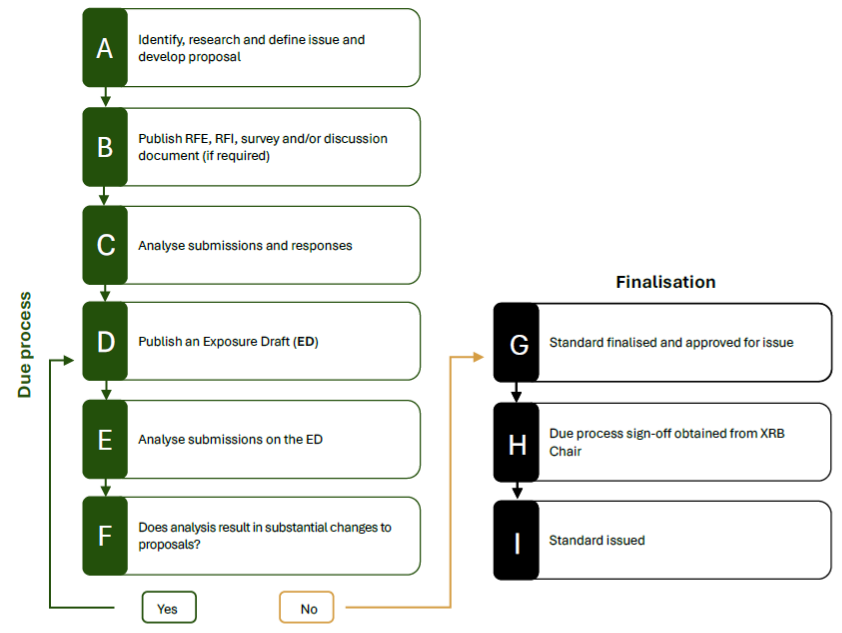
We develop and issue financial reporting, auditing and assurance, and climate standards for for-profit, not-for-profit and public sector entities. Before issuing a standard, we undertake due process.
Our general due process is summarised in the above diagram and is consistent with international best practice.
The process is applicable to the development and issue of domestic standards. However, some modifications to this process are made in relation to international standards, NZ equivalents to those standards, and PBE Standards based on international standards, for example, we may consult concurrently with the international body, etc. This process is detailed further in the explanatory guides linked below.
Section 22 of the Financial Reporting Act 2013 (FR Act) requires us to take reasonable steps to consult the persons or representatives of persons who, in the opinion of the Board, would be substantially affected by the issue of the standard. It also requires us to consult with the Privacy Commissioner if a standard is likely to require the disclosure of personal information.
The XRB Board has developed a set of due process guidelines which the NZASB and the NZAuASB must follow before issuing a standard.
For a detailed description of how our standards are set, read the following documents. They set out the full processes for setting both accounting standards and auditing and assurance standards:
- Overview of the Accounting standard setting process
- Overview of the Auditing and assurance standard setting process
 Overview of the Accounting Standard-Setting Process
These guides are being reviewed and updated. An explanatory guide setting out the sustainability standard-setting process is also being developed.
Once the consultation period is complete, we finalise and then issue the standard
The final stages of the standard setting process (G to I above):
- Once the exposure and consultation period is completed and the comments received have been considered by the technical board (NZAuASB, NZASB or SRB), the technical board should finalise the standard and approve it for issue.
- Before approving it for issue the technical board is required to specifically consider and satisfy itself (as a final check):
- that consultation was undertaken in accordance with section 22 of the Financial Reporting Act 2013
- that reasonable steps have been taken to consult with people or organisations likely to be affected by the proposed standard, or representatives of such persons or organisations including those views of Māori, as necessary
- that due process has been followed, and that matters raised by constituents have been adequately considered. (In the case of a standard that is based on an international standard, this includes ensuring that the applicable international due process has been followed)
- the standard is consistent with the XRB Board’s strategies
- the proposed standard is likely to achieve its objectives and that the benefits and costs of the standard are sufficient to justify its issue
- that harmonisation impacts on Australian auditing and assurance standards or Australian reporting by for-profit entities from the issue of the proposed standard have been considered
- the Privacy Commissioner has been consulted under section 22(2) of the FR Act 2013, where the standard is likely to require the disclosure of personal information; and
- whether there are any other matters the technical board considers should be drawn to the attention of the XRB Chair or the designated alternate.
- Where appropriate, the technical board may issue a Basis for Conclusions document setting out the main matters raised in the submission and the decisions made by the technical board when finalising the standard.
- The technical board then obtains a Certificate of Determination signed by the XRB Board Chair (or alternate), as required by section 26 of the FR Act in accordance with the Board Communications Protocol.
-
Following receipt of the Certificate of Determination, the technical board issues the standard. XRB staff then undertake a process to gazette and publish the standard. This involves publishing a notice in the Gazette, sending copies of the standard to the House Office and our Minister for the Minister to present the standard to the House of Representatives, publishing the standard on the XRB’s website, and notifying stakeholders about the new standard through our communication channel/s.
We notify publicly when we issue a standard
The notification appears on the recently issued page of our website and via our Accounting Alert, Auditing & Assurance Alert, or Climate Alert as appropriate.
Read Audit & Assurance Alerts here
Notifications also appear in the NZ Gazette — the official Government newspaper and authoritative journal of constitutional record.
Our standards are secondary legislation
Under section 25 of the Financial Reporting Act 2013, the following are secondary legislation (see Part 3 of the Legislation Act 2019 for publication requirements):
(a) a standard:
(b) an authoritative notice:
(c) an amendment or revocation of a standard or authoritative notice.
This means that these items must be presented to Parliament in accordance with Parliament’s rules and practice.
Under section 114 of the Legislation Act 2019, the Minister must present secondary legislation to the House of Representatives in accordance with the House’s rules and practice
Under section 117 of the Legislation Act 2019, Parliament may, by resolution within 21 sitting days, disallow a standard.
References to "standard/s" above also include notices, amendments, or revocations.
Find standards, notices, amendments or revocations on our website below